The Redskins 1996 NFL Draft was defined by bold decision-making, calculated risk and one fourth-round selection that would go on to become one of the most productive running backs in franchise history. Washington entered draft day without a first-round pick — having traded it for defensive tackle Sean Gilbert — but still managed to come away with genuine building blocks for the future.
No First Round Pick, No Problem
Trading your first-round pick is always a gamble. Washington had dealt theirs to acquire Gilbert, leaving general manager Charley Casserly to work with what he had. However, rather than play it safe, Casserly remained aggressive throughout the process — a philosophy that would define the most dramatic moment of Washington’s draft weekend.
A Panic at the Tackle Position
Washington entered the second day with a clear priority — offensive tackle. Jim Lachey’s career was winding down and the franchise desperately needed his long-term replacement. The Redskins had identified Andre Johnson of Penn State as their man and held the seventh pick of the second round. Then the first round started eating into their plan.
Jermane Mayberry went to Philadelphia at 25. John Michels went to Green Bay at 27. Pittsburgh grabbed Jamain Stephens at 29. Suddenly Washington’s options were evaporating. Furthermore, Tampa Bay — sitting two spots ahead of the Redskins in the second round — had missed on a tackle in the first round and was widely expected to grab one early on day two. Casserly had seen enough.
Casserly Makes the Move
Rather than sit nervously and hope Johnson was still available, Casserly traded a third-round pick to the Dallas Cowboys to jump from the seventh spot in the second round all the way up to the 30th pick of the first round. Washington got their man before Tampa Bay could strike.
“I think everyone in the NFL knew we wanted to take an offensive tackle,” Casserly said. “The decision was — let’s make the deal, get the player and then we have it done, instead of sitting there hoping and praying.”
Casserly had discovered Johnson while scouting Illinois defensive end Simeon Rice. He watched Penn State film and saw Johnson completely neutralize Rice — no sacks, no tackles. Now Johnson would block Rice twice a year in the NFC East.
Unfortunately for the Redskins, Andre Johnson was one of their biggest busts ever. He played three NFL games. And they were for the Detroit Lions.
The Real Steal: Stephen Davis
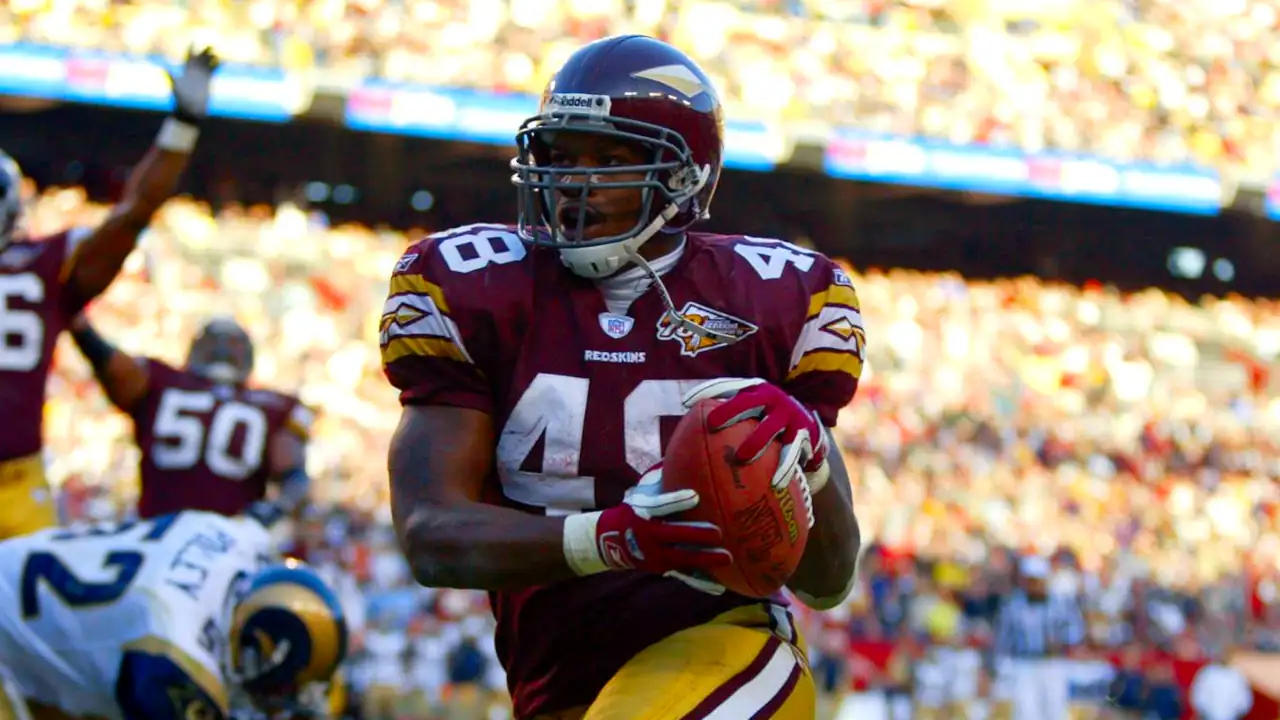
Washington used only one pick on the opening day of the draft. However, they more than made up for it with their fourth-round selection. Running back Stephen Davis out of Auburn fell dramatically due to concerns about arthroscopic knee surgery and a reduced carry count in his senior year. Washington had him rated significantly higher and pounced.
Running backs coach Bobby Jackson compared Davis to Herschel Walker and Chris Warren — high praise that would ultimately prove justified. Davis arrived as a backup to Terry Allen but developed into one of the most powerful and productive runners in franchise history. The Redskins, consequently, believed they had found a steal from the moment they made the pick.
“Stephen could be a steal,” Jackson said. “He has outstanding athletic ability, size, speed and production in a big time league.”
He played 11 NFL seasons and had over 8000 yards rushing. Seven of those seasons, and 5790 of those yards, were as a Redskin. Good enough for fourth all time in Washington. What a pick.
The Rest of the Class
Washington’s remaining picks offered modest upside. Safety Leomont Evans out of Clemson came with a genuinely unusual backstory — he had collapsed during a college practice and been diagnosed with hyperglycemia, attributed to eating too much chocolate. Health concerns aside, the Redskins viewed him as a solid run defender in the mold of strong safety James Washington.
Linebacker Jeremy Asher of Oregon and wide receiver Deandre Maxwell of San Diego State — a nephew of veteran Henry Ellard — were considered longshots from the start. Defensive end Kelvin Kinney from Virginia State was Washington’s annual late-round developmental “fun pick,” following in the footsteps of Dexter Nottage and Rich Owens who had both made the roster in previous years.
A Notable Footnote
The trade with Dallas raised eyebrows given the fierce rivalry between the two franchises. When asked what his late mentor George Allen would have thought about dealing with the Cowboys, Casserly delivered a sharp and memorable response.
“First of all, George wouldn’t have had the second and third round picks to trade,” Casserly said, “because they would have been gone four years ago.”
With the picks acquired from Washington, Dallas selected defensive end Kavika Pittman and center Clay Shiver. Pittman played 8 years in the NFL, 4 of them for Dallas. Shiver played 3 seasons in Dallas.
In Summary
The Redskins 1996 NFL Draft was not a glamorous class by any measure. Washington had no first-round pick and limited ammunition throughout. Nevertheless, Casserly drafted with purpose and conviction. Andre Johnson flopped massively. Stephen Davis, however, was the real prize — a fourth-round find who would go on to carry the franchise on his back in the years ahead.
By the modest standards of mid-1990s Washington football, the 1996 draft was a quiet success.
Redskins 1996 NFL Draft Selections
Round, Pick, Player, College
1, 30, Andre Johnson, Penn St.
4, 102, Stephen Davis, Auburn
5, 138, Leomont Evans, Clemson
6, 174, Kelvin Kinney, Virginia St.
7, 215, Jeremy Asher, Oregon
7, 250, DeAndre Maxwell, San Diego St.
Notes:
Read more about the entire Sean Gilbert saga.